Solheim Cup 2026 Review: Europe Reclaim the Cup in a Sunday Thriller
Sep 13, 2026I sat watching the final day of the Solheim Cup with the remote control working almost as hard as the players.
On one screen, Europe and the USA were locked in a compelling singles contest at Bernardus Golf in the Netherlands. At the same time, I was flicking across to the Formula 1 in Spain and keeping an eye on the DP World Tour’s Irish Open.
It was one of those wonderful, slightly chaotic sporting Sundays—but the Solheim Cup kept pulling me back.
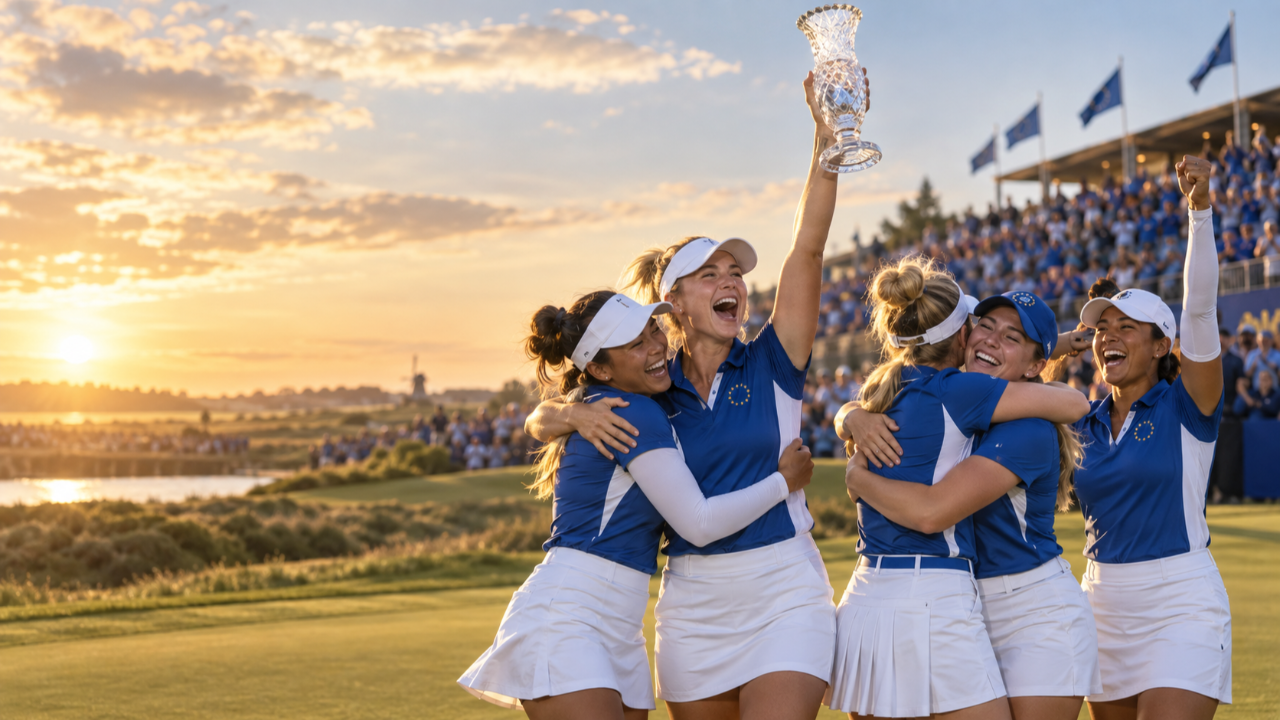
By the end, Europe had reclaimed the trophy with a thrilling 15–13 victory, and Anna Nordqvist had completed her final week in professional golf as a winning captain.
A weekend that never stopped moving
The final score tells us Europe won by two points, but this contest felt far closer than that.
Friday finished 4–4. Europe then won Saturday morning’s foursomes 3–1, only for the USA to answer by taking the afternoon fourballs 3–1. After 16 matches, it was 8–8.
The two sides arrived at Sunday exactly level, but carrying very different emotions. Europe had produced some of the best partnership golf of the week. America, inspired by Jennifer Kupcho’s extraordinary finish on Saturday evening, had landed the last punch.
Kupcho holed from around 91 feet on the 17th and then made another huge putt on the 18th to turn the final fourball match in America’s favour. Those were the moments everyone was still discussing as Sunday’s singles began.
Europe needed 61⁄2 points to win the Cup. The USA, as holders, required six to retain it.
Pairings: the good, the bad and the brave
Before getting to the singles, the pairings told much of the story of the opening two days.
For Europe, Maja Stark and Linn Grant were outstanding together. Their chemistry looked natural and their golf was authoritative. They won all three of their matches as a partnership, including an impressive 3&2 victory over Nelly Korda and Allisen Corpuz—the first defeat for an American pairing that had won five consecutive Solheim Cup matches together.
Leona Maguire and Esther Henseleit were another excellent foursomes combination, winning both of their matches. Maguire’s record and competitive personality continue to make her look made for this event.
Then there were the European rookies. Mimi Rhodes and Nastasia Nadaud looked completely at home, combining for two victories and bringing a freshness and fearlessness to the side. Nadaud, the youngest player in the contest at 21, would finish the week with three points from four matches.
Not everything worked. The decision to play Charley Hull and Lottie Woad together in all four partnership sessions produced only half a point. Their 6&5 defeat on Saturday morning was particularly difficult.
On paper, the pairing was understandable: England’s two highest-profile players and two exciting attacking golfers. In practice, it never settled.
Anna Nordqvist’s loyalty to them was certainly brave and, for much of the weekend, open to question. Yet Sunday gave both players the opportunity to change the story—and they did.
That is one of the fascinating things about team golf. Rankings and statistics can suggest a combination, but chemistry, communication and momentum often decide whether it actually works. As coaches, we should never forget the person behind the numbers.
Hull gives Europe the fast start it needed
Nordqvist sent Charley Hull out first against Megan Khang.
After such a difficult opening two days, that was both a show of faith and a challenge: go out, take responsibility and set the tone.
Hull responded superbly, winning 3&2.
That first blue point mattered. It settled the European team and immediately changed the atmosphere around the course. After spending two days being questioned, Hull produced exactly the assertive singles performance her captain had hoped for.
The scoreboard then moved both ways. Alison Lee edged Esther Henseleit 1 up for the USA, while Linn Grant produced another excellent display to beat Angel Yin 4&3. Nelly Korda answered with a 4&2 victory over Mimi Rhodes.
The overall contest was still tight, but blue began appearing further down the board.
The rookies delivered under pressure
Europe’s less-experienced players did not look overawed by the situation.
Nastasia Nadaud defeated Andrea Lee 3&2 to complete a brilliant debut week. Julia López Ramírez then beat Yealimi Noh 3&2, rolling in a confident birdie putt on the 16th to close the match.
Nanna Koerstz Madsen added another vital point by beating Allisen Corpuz 2&1.
These were not points gathered after the contest had been decided. They came while the Cup was still in the balance and the scoreboard was tightening. That is a very different type of pressure.
The performances of Nadaud and López Ramírez in particular said a great deal about Europe’s future. They did not merely participate in the occasion; they shaped it.
Lottie Woad changes her own story
Perhaps the most satisfying turnaround belonged to Lottie Woad.
After taking only half a point from four partnership matches with Hull, Woad could easily have carried that disappointment into Sunday. Instead, she beat Auston Kim 2&1.
Her match was not straightforward. Kim produced a spirited fightback and reduced Woad’s lead, but the young English player stayed composed. When Kim could not make the putt she needed on the 17th, Woad completed the victory.
At that moment, with Carlota Ciganda already guaranteed at least half a point in the match behind, Europe could no longer be denied.
Woad had gone from feeling that she had let the team down to delivering the point that made the outcome inevitable. It was a wonderful example of resilience and of why a player’s week cannot be judged before the final ball has been struck.
Ciganda makes it official
If there was one player Europe would have wanted in position to finish the job, it was probably Carlota Ciganda.
Ciganda seems to find an extra emotional and competitive level in the Solheim Cup. She had already produced a dramatic finish on Friday and now faced Jennifer Kupcho—the American whose two enormous putts had transformed Saturday evening.
The storyline could hardly have been better.
Ciganda went 3 up, saw Kupcho begin to threaten a comeback, then holed a magnificent long putt on the 13th to restore her advantage. She eventually won 4&2, and Europe officially had the point required to reclaim the Cup.
Woad’s victory had made it inevitable. Ciganda’s made it official.
The remaining matches took the final score to Europe 15, USA 13. The singles session itself finished 7–5 to Europe.
A remote-control sporting Sunday
As the tension built, I was still occasionally flicking across to events elsewhere.
In Madrid, Kimi Antonelli won the Spanish Grand Prix ahead of Max Verstappen and Lando Norris, with strategy playing a major part. Meanwhile, the Irish Open was unfolding on the DP World Tour.
But every time I changed channel, I found myself quickly returning to Bernardus.
That is the power of team match play. A conventional tournament gives us a leaderboard; the Solheim Cup gives us 12 separate stories happening at once. A missed three-footer in one match can change the pressure in another. A player who has struggled for two days can suddenly become the hero. Momentum moves across a golf course in a way that no statistic can properly capture.
Anna Nordqvist’s final chapter
The victory was also a fitting conclusion for Anna Nordqvist.
Having announced that this would be her final week in professional golf, she leaves it as a winning Solheim Cup captain. Her decisions were not beyond criticism—particularly the persistence with Hull and Woad—but captaincy should ultimately be judged across the whole contest.
Her players were ready for Sunday. They started quickly, the rookies delivered, and two golfers who had struggled together over the first two days both won their singles matches.
That does not mean every decision was retrospectively perfect. It means Nordqvist maintained belief in her players and created an environment in which they were able to respond.
There is an important coaching distinction there. Supporting a player is not the same as pretending that performance does not matter. The best support allows honest assessment without taking away belief.
What Europe’s victory showed
Europe won because it found contributions throughout the team.
The established names delivered: Hull, Grant and Ciganda all won important singles matches.
The rookies delivered: Nadaud and López Ramírez were excellent under pressure, while Woad produced her defining moment when it mattered most.
The partnerships delivered: Stark and Grant, Maguire and Henseleit, and Rhodes and Nadaud gave Europe a strong foundation over the first two days.
And when America fought back—as we knew it would—Europe did not panic.
The USA played its part in a superb contest. Kupcho’s Saturday finish will remain one of the enduring memories of the week, while Korda, Alison Lee, Lauren Coughlin, Lindy Duncan and Rose Zhang all won singles points on Sunday.
But this was Europe’s day.
Sitting there watching it unfold, with the F1 and Irish Open competing for attention, I was reminded again why the Solheim Cup is one of the best events in golf. It had quality, pressure, personality, questionable decisions, brave responses and a finish built around redemption.
Europe 15 – USA 13.
The Solheim Cup is back in European hands—and what an exciting way to win it.
Don't miss a beat!
New moves, motivation, and classes delivered to your inbox.
We hate SPAM. We will never sell your information, for any reason.